Kissin exhumes a compelling Scriabin rarity in BSO’s all-Russian program
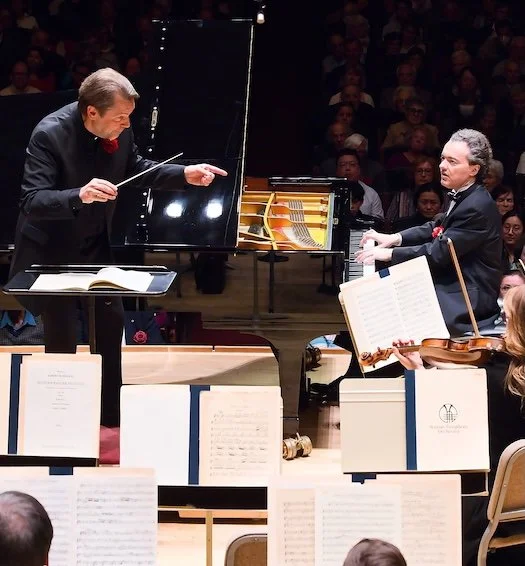
Evgeny Kissin performed concertos by Mozart and Scriabin with conductor Andrey Boreyko and the BSO Thursday night. Photo: Hilary Scott
Evgeny Kissin and Andrey Boreyko restored a seldom-heard Scriabin concerto to the Boston Symphony Orchestra’s repertoire Thursday night at Symphony Hall, anchoring a Russian-leaning program of Romantic fantasy.
The evening’s main work was Scriabin’s Piano Concerto in F-sharp minor, Opus 20. This rarity was accompanied by an early Mozart concerto and shorter works by Rimsky-Korsakov and Anatoly Liadov,
The evening opened with Rimsky-Korsakov’s Russian Easter Overture.Boreyko shaped each line precisely and expressively, crafting the opening measures sans baton. The overture’s many colors were expertly calibrated from the first moments, with gripping brass articulation and a light-hearted flute solo. Boreyko yet maintained an underlying tension, at times beckoning for more from the strings. In the fiery closing pages, where Rimsky’s orchestration piles brass fanfares atop Orthodox melodies, the orchestra’s forceful playing seemed to meet Boreyko’s beseeching gestures.
Kissin made his first appearance of the evening in Mozart’s Piano Concerto No. 12 in A major, K. 414—a chamber-scaled, lyrical work scored lightly enough that Mozart himself could perform it with a string quartet. In this early Mozart work, Kissin blended heartfelt expression and vivacity, playing the opening movement in a clean and straightforward manner. The Andante proved the highlight with Kissin and Boreyko working closely as partners, shaping phrases with particular care and tenderness—a fitting temperament for a movement believed to mourn the recent death of Mozart’s friend and mentor Johann Christian Bach.
The evening’s most transporting music followed the intermission with three brief tone poems by Liadov. Baba Yaga was an energetic work, scattered and frantic. The Enchanted Lake provided the concert’s highlight with Liadov’s score evoking stillness through shimmering string tremolos and veiled woodwind figures. The orchestra’s characteristic restraint, a limitation in the Rimsky-Korsakov, became a prized asset allowing Liadov’s aquatic depiction to emerge fully. Kikimora was all suspense and mischief. The musicians channeled the character of this malevolent spirit, articulating the harsh transitions.
Kissin returned to the stage for Scriabin’s Piano Concerto, a work only performed twice before by the BSO, and not heard at Symphony Hall in 25 years.
Scriabin composed the concerto in 1896 at age 24 as his first work for orchestra. Cast in three movements and lasting roughly 30 minutes, the piece stands apart from the muscular Russian tradition of Tchaikovsky’s First and Rachmaninoff’s Second and Third Concertos. There is no extended cadenza, no thundering declamation, no bravura showpiece to conquer. Scriabin’s piano writing is intimate, closer to Chopin than to his countrymen.
The first movement’s opening descending figures were voiced with a soft, singing touch. Kissin’s rubato was supple, but the line unbroken. The second movement opened with the chorale-like theme in muted strings, and Kissin entered with arpeggios that seemed to hover above rather than drive the music forward. Only in the finale’s closing pages did Kissin unleash the full measure of his virtuosity, its perpetual-motion figures and syncopated accents demanded the evening’s most athletic playing—a thrilling late reward for a performance that otherwise prized restraint and poetry.
The standing ovation was immediate and sustained. Kissin returned to the stage three times, and by the third appearance it seemed an encore might follow. It did not—a small disappointment at the close of an otherwise richly rewarding evening.
The program will be repeated 8 p.m. Saturday at Symphony Hall. bso.org