Arrow Quartet fluently explores Mozart and his predecessors in Cambridge
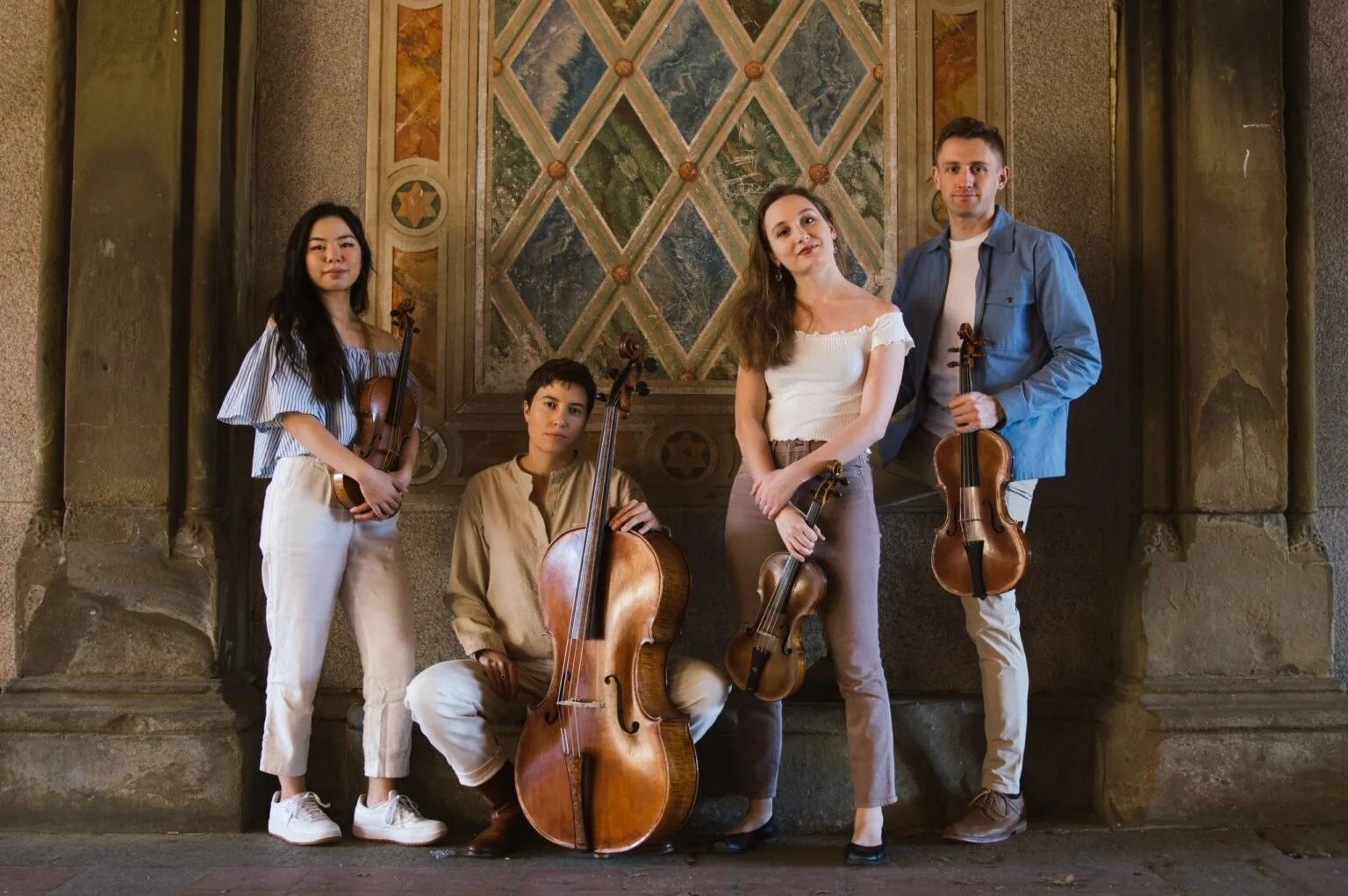
The Arrow Quartet performed Friday night in Cambridge.
In its season finale Friday night, the Cambridge Society for Early Music presented the young Arrow Quartet in an illuminating performance tracing the development of the string quartet with works by Richter, Cambini, and Mozart.
Violinists Amelia Sie and Alyssa Campbell, violist Philip Rawlinson, and cellist Chelsea Bernstein (who lent her dog’s name to the ensemble) brought genuine conviction to a program that ran the risk of being an academic exercise.
Specializing in historically informed performance, the foursome founded the quartet in 2021 at Juilliard’s Historical Performance program and came to Friday’s concert at University Lutheran Church with both the gut strings and the interpretive instincts the repertoire demands.
Franz Xaver Richter’s String Quartet in G minor, Op. 5, no. 5b, opened the evening. An Austro-Moravian composer of the Mannheim School, Richter straddled the Baroque and Classical eras: old-fashioned enough to cling to counterpoint when his colleagues had moved on, yet forward-thinking enough that Mozart praised his work.
Richter’s quartet, dated 1772, is a hybrid of the two periods. Rather than opening with a faster first movement, this 17-minute work begins with a Larghetto anchored in Baroque counterpoint, and Sie led with quiet authority from the first note. The Allegro Spiritoso arrived with driving rhythms, dramatic dynamic shifts, and Classical-era modulations cycling through the ensemble. This is tricky writing for historical instruments, and the quartet dispatched it with ease.
The Andantino Grazioso offered lyrical inner voices stepping forward with melodic prominence. The quartet leaned into the movement’s chromaticism so fully that each harmonic change felt like the gravity had also shifted.
The Tempo di Minuetto came last, an unusual finale for the form. The Baroque counterpoint returned with courtly clarity, and the ensemble was crisp in their articulations. Like the movements before it, it ended without ceremony, a quality that feels less like an oversight than a trait of Richter’s blended style.
Where Richter belonged to Mannheim, Giuseppe Cambini belonged to Paris, a prolific Italian expatriate whose 149 string quartets made him one of the most performed composers in the city during the 1770s and 80s.
His String Quartet in F Major opened with characteristic elegance, Campbell now at first violin, extracting run after run with seemingly inexhaustible energy. Bernstein and Rawlinson made the end of the movement their own, the body and bite of their playing lifting it to a satisfying close.
The lyrical Larghetto Cantabile was cello-forward and convincing, if not transcendent. The Minuetto brought the first pizzicatos of the evening, strings punctuated and rhythmically sharp. The finale found Campbell in Vivaldi territory, fleet and brilliant, while Rawlinson drove a relentless ostinato beneath her toward a grand close.
The evening’s highlight was Mozart’s String Quartet in E-flat Major. As the third of six quartets he dedicated to Haydn, this is the work the entire evening built toward.
Sie returned to first violin for K. 428, all four voices entering on a unison E-flat before the harmony lurched sideways onto an A natural—the “devil’s interval,” landing like a question mark before the movement had properly begun. The quartet’s dynamic control shaped Mozart’s harmonic shifts with enough weight that each modulation registered as an event.
The Andante con moto belonged to Bernstein, whose dark-toned cello line anchored the movement while the violins glided above it. The quartet sharpened their dynamic contrasts around each cadence, keeping the music from settling too comfortably. Leaning into the articulated downbeats and staccato upbeats, the Arrow Quartet made the Minuetto feel genuinely dancelike in a way the previous works, courtly and pleasant as they were, never quite achieved.
The Allegro Vivace closed the program in a hurried, scurrying rush, equal parts athletic and lyrical, the quartet locked in and coordinated to the last note.
Friday night suggested an ensemble still growing into its potential, technically assured, interpretively thoughtful, and worth following. The most demanding corners of the quartet repertoire remain ahead of them.
The program will be repeated 4 p.m. Saturday at Village Church in Weston and 4 p.m. Sunday at St. John’s Episcopal Church in Beverly Farms. csem.org.
This review was originally published on the Boston Classical Review